On a dark stretch of Virginia coastline where the Atlantic meets the mouth of the Chesapeake Bay, the United States built its first statement of national purpose. It wasn’t a monument or a capitol building. It was a lighthouse.
That’s not a small thing. It tells you exactly what a young republic understood about its own survival.
The Problem at Cape Henry
For early American sailors, the waters at Cape Henry were a graveyard. The shifting shoals where the Atlantic meets the Chesapeake had claimed dozens of ships, and the damage wasn’t just measured in lives. The Chesapeake Bay was the economic spine of the new nation — the waterway that fed commerce from Virginia to Maryland and beyond. Ships entering without guidance ran a genuine risk of dying on the shoals that guarded the bay’s mouth, and the appeals for a lighthouse had been piling up for years.
The colonial government of Virginia had actually started building one in the 1770s, quarrying sandstone and beginning construction on the site. Then the Revolution interrupted everything. Work stopped. Materials were stolen or swallowed by the sand. The unfinished tower was abandoned, and the shoals kept claiming ships.
The Ninth Law of the First Congress
On August 7, 1789, Congress passed the Lighthouse Act — the ninth law enacted by the First Congress under the new Constitution. It established a federal system for lighthouses and authorized their funding and construction. The following year, funds were appropriated specifically for Cape Henry. President Washington approved it. Alexander Hamilton, as Treasury Secretary, oversaw the execution.
The federal government would finish what the colonies had not.
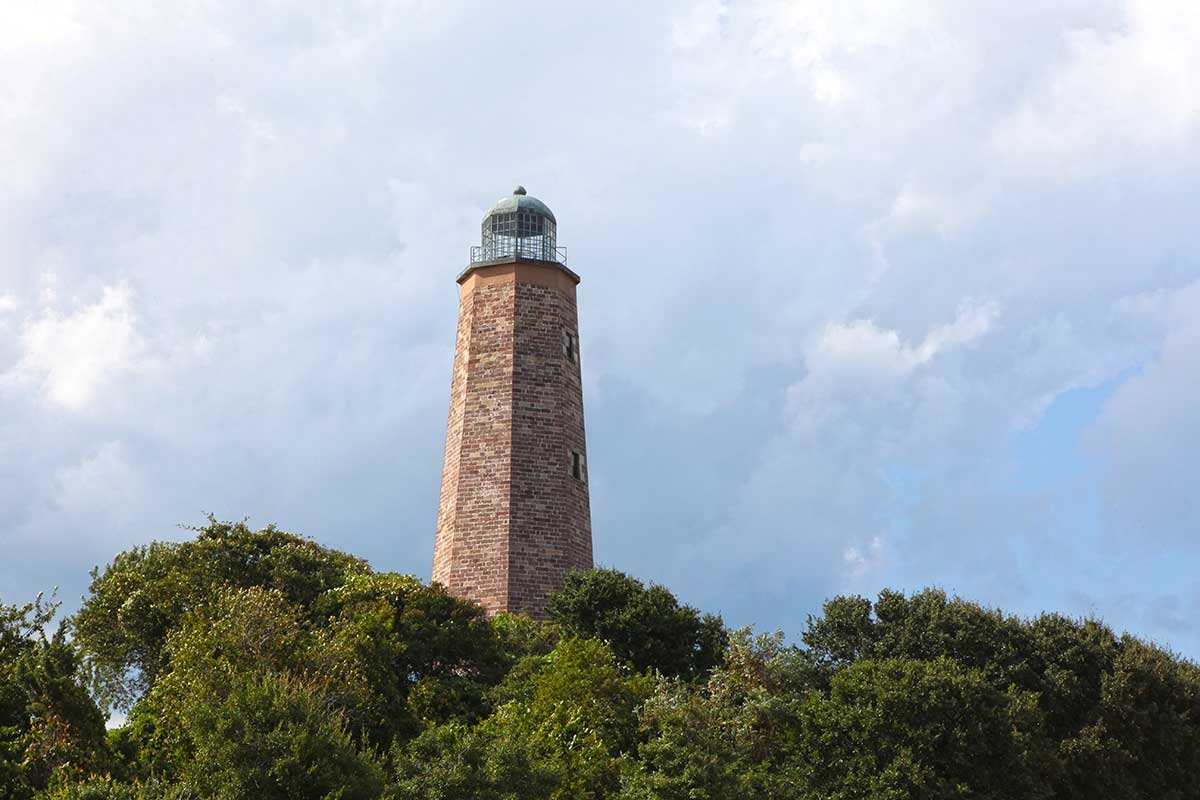
New York builder John McComb Jr. — a master architect who would later contribute to New York City Hall — was contracted to complete the octagonal tower. The material chosen was Aquia Creek sandstone, quarried from the same Virginia pits that supplied stone for the White House and the United States Capitol. The choice was not incidental. This lighthouse was built from the same material as the institutions of the republic itself, and it was meant to mean something.
The octagonal tower rose ninety feet above the sea. By October 1792, the light shone for the first time — fueled initially by sperm whale oil lamps, later improved with Argand-style burners, and eventually electrified. The beam swept across both the Atlantic and the Chesapeake, guiding warships, merchant vessels, and generations of sailors through the most dangerous approach on the East Coast.
Climb its 191 winding steps today and the chisel marks of its stonemasons are still visible in the stone. The hands that built this thing left their traces in it.
The Second Lighthouse
The old tower had limits that time made impossible to ignore. Its soft sandstone eroded. Cracks appeared in the 1870s. The height proved insufficient for the growing traffic of a nation expanding toward both coasts. Then in 1877, the USS Huron — a U.S. naval steamship — wrecked nearby with significant loss of life. The message was clear.
In 1881, just 350 feet from the original tower, an iron lighthouse rose. Taller, stronger, and crowned with a first-order Fresnel lens — a masterpiece of glass and precision engineering capable of casting its beam nearly nineteen miles out to sea. It was everything the Industrial Age could offer to the problem the republic had first addressed with sandstone and whale oil nearly a century earlier.
The original lighthouse would typically have been dismantled at this point. Its historical significance was already recognized, and it was preserved instead.
Two Lighthouses
Cape Henry is one of the rarest sights in America: two historic lighthouses standing side by side, separated by 350 feet and nearly a century of engineering progress. The 1881 iron tower still operates today as an active aid to navigation under the U.S. Coast Guard. The original 1792 tower — a National Historic Landmark — is cared for by Preservation Virginia on the grounds of Joint Expeditionary Base Fort Story, near the site where English colonists first landed in 1607.
The oldest and the newest. The colonial aspiration and the federal achievement. A sandstone tower built from the same quarry as the Capitol, standing beside an iron giant built to replace it, both still standing on the same stretch of Virginia coastline where the new nation first decided that keeping sailors alive was worth the government’s attention.
That was the ninth law. It still matters.