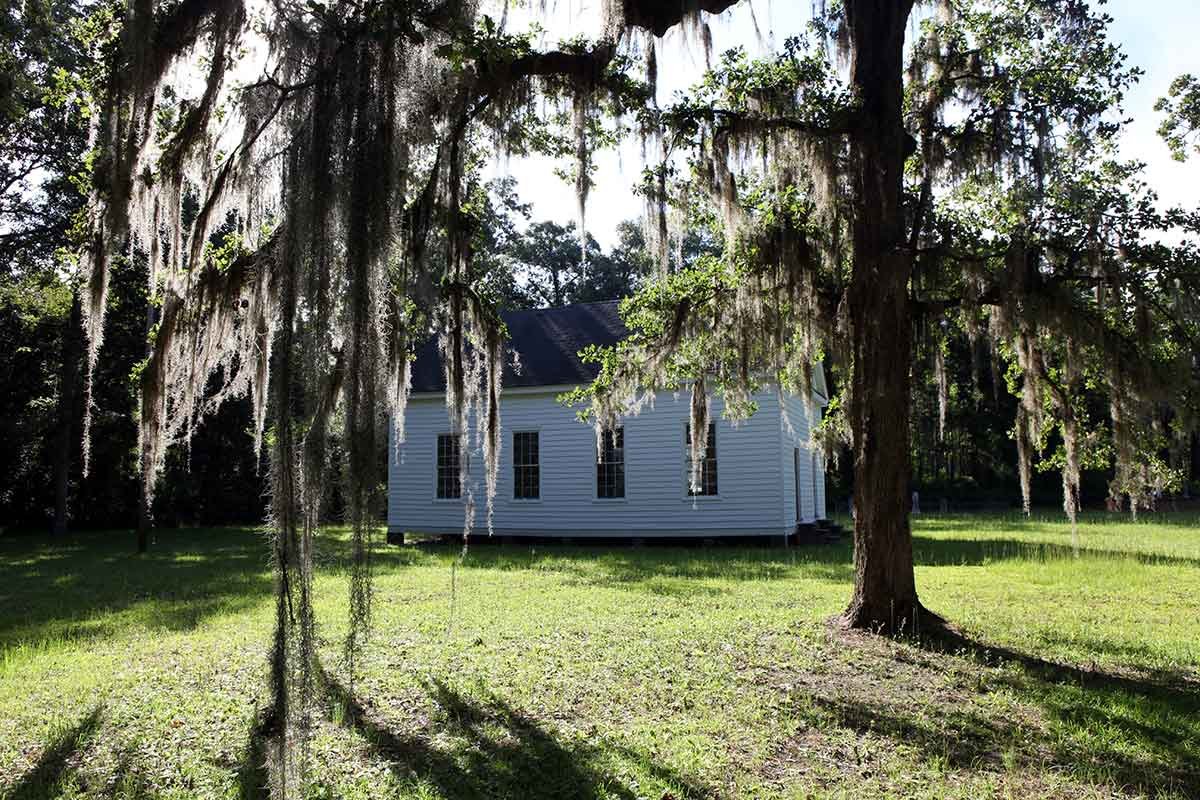
Along a quiet stretch of Dorchester County, a small white church built around 1840 still stands — and its walls remember everything.
Along a quiet stretch of Wire Road in Dorchester County, South Carolina, there stands a small white church that time seems to have forgotten. No steeple. No bell. Just wood, light, and a very long memory.
Built around 1840, the building is modest almost to the point of anonymity. But step inside and the interior tells a more complicated story. The layout is a blueprint of a vanished social order — one organized not just by faith, but by the rigid hierarchies that governed every aspect of antebellum Southern life. Two front doors opened onto a divided world: men entered from the north side, women from the south. At the back of the church, a separate door allowed the enslaved to enter — present for the same service, kept apart from it in every way that mattered.
They worshipped in the same room and in entirely different worlds.
The architecture wasn’t incidental. It was doctrine made physical — a building that encoded the social order into every threshold and pew assignment, so that even the act of walking through a door reinforced who you were and where you stood.
The Last Piece of Home
In 1862, the churchyard became something else entirely. Captain Morgan T. Appleby mustered Company C of the 24th South Carolina Infantry here, among these same oaks and this same plain white facade. For many of those men, it was the last familiar place they ever stood. The last piece of home before the war swallowed them.
How many came back is a harder question. The Confederacy’s losses in the campaigns that followed were severe, and rural Dorchester County communities like this one felt those absences for generations.
What Outlasted Everything
By the 1940s, the pews were empty. The congregation had scattered or aged out, and the church quietly ceased to function as a living place of worship. But the building endured — the wood, the doors, the divided thresholds, all of it.
There is something worth sitting with in that fact. The congregation is gone. The hierarchy that organized their seating is gone. The theology that made a separate rear entrance seem not only acceptable but ordained — gone. The building outlasted all of it. It stands now not as a monument to what it once enforced, but as a witness to it. A place where the past is not reconstructed or interpreted. It’s just there, in the wood grain and the doorframes, waiting for anyone who takes the time to look.