On a summer morning in 1973, two children playing on the dunes of Nags Head, North Carolina, noticed a bulldozer moving toward the sand. They ran home and told their mother.
Their mother’s name was Carolista Baum, and what she did next is why Jockey’s Ridge State Park exists today.
Baum ran to block the machine in its tracks. That evening, after the construction workers abandoned their posts, she removed the distributor caps from the dozers, delaying the work even further. Then she started organizing. She formed a group called People to Preserve Jockey’s Ridge and began collecting signatures on a petition to save the dunes. In 1974, Jockey’s Ridge was declared a National Natural Landmark, and in 1975 state legislators purchased 194 acres of sandy land and created Jockey’s Ridge State Park.
The dune that almost became a residential development is now one of the most visited state parks in North Carolina.
What You’re Looking At
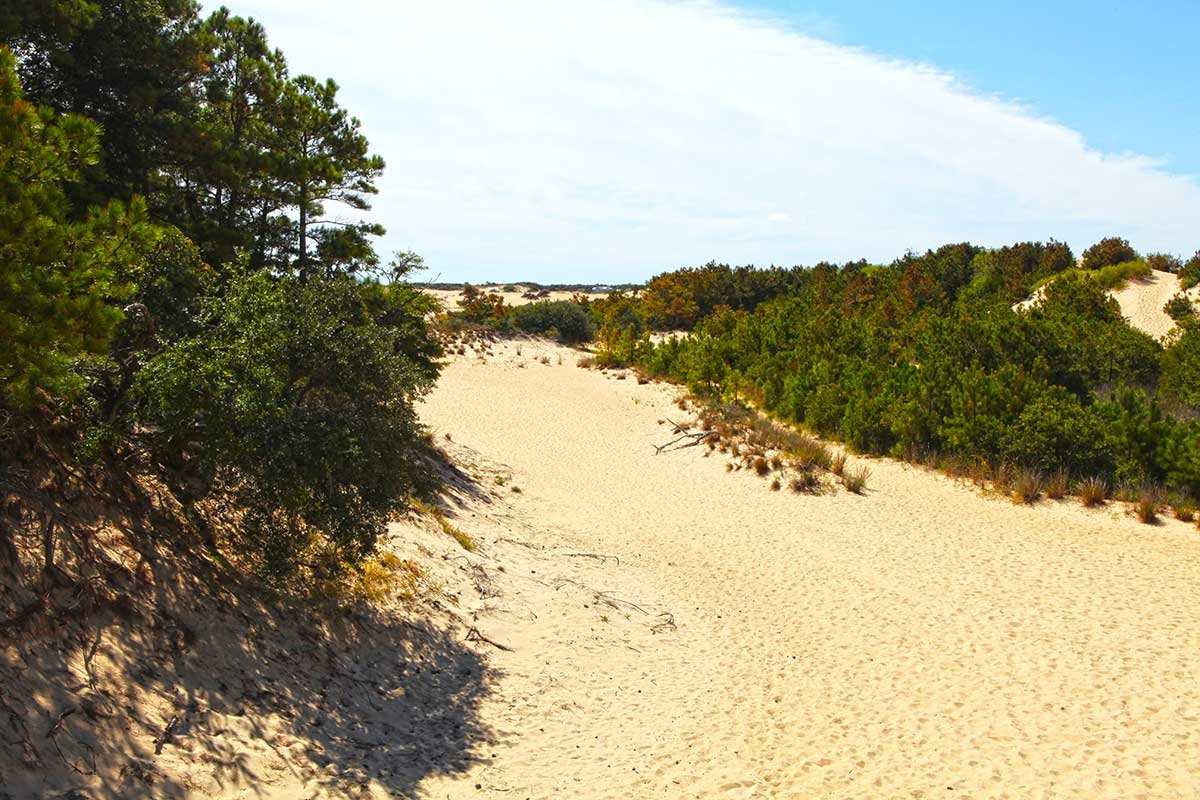
Jockey’s Ridge is the tallest living natural sand dune system in the Eastern United States, with a height that varies from 80 to 100 feet depending on weather conditions. Shifting maritime winds blow billions of grains of sand in different directions, constantly changing both the shape and size of the dune.
Scientists believe the dune itself came into being about 7,000 years ago, formed as minerals like quartz were washed from the mountains to the ocean, pushed onto the beaches by storms and hurricanes, and eventually blown inland through a process called saltation. What stands in Nags Head today is the result of several thousand years of wind doing quiet, patient work.
But the sky does its part, too. As the highest point on the coastline, the ridge is a frequent target for lightning. When a bolt hits this high-silica sand, it instantly melts it into ‘fulgurites’—strange, fragile tubes of natural glass that mirror the path of the lightning strike beneath the surface.
The tall dune area is known as a medano — a massive, asymmetrical, shifting hill of sand lacking vegetation. It looks more like something you’d find in the Sahara than on a North Carolina beach town, which is part of what stops people in their tracks when they see it for the first time. Stronger winds in winter blow the dunes about one to six feet to the southwest each year.
The dune is always moving. It is never quite the same place twice. In fact, it is a graveyard for things left in its path. In the 1980s, the shifting sands completely swallowed a nearby miniature golf course; today, locals still wait for the wind to shift just right to catch a rare, fleeting glimpse of a castle turret or a fence post peeking through the sand.”
A Long History
The ridge has been a landmark far longer than it’s been a state park. In the 1500s, sailors used Jockey’s Ridge as an important landmark to navigate their ships along the coast. It was visible from sea, a reliable fixed point on a coastline notorious for wrecking ships.
One popular legend about the name comes from the “Bankers” — local residents who captured and raced Spanish Mustangs descended from horses that swam ashore from wrecked offshore ships. The steep sides of the ridge served as a natural grandstand for spectators watching the races below. Whether that story is history or folklore is debated. Either way, it fits.
What to Do Here
The dune draws a wide range of visitors for reasons that have nothing to do with history. The sand dunes at Jockey’s Ridge reach up to 100 feet tall and are the tallest in the Eastern United States, making the park a popular destination for hang gliding, sandboarding, hiking, birdwatching, kite flying, and watching the sunset.
The hang gliding is worth mentioning specifically. The combination of steady coastal winds and a soft sand landing zone makes this one of the better places on the East Coast to learn, and lessons have been available here since the 1970s. Standing at the top of the dune watching someone catch a thermal and lift off the ridge, it is hard not to think about the Wright Brothers, who did their own early gliding experiments just a few miles up the road at Kill Devil Hills.
Jockey’s Ridge State Park is also the official eastern endpoint of North Carolina’s Mountains-to-Sea Trail, a hiking route that crosses the entire state from the Great Smoky Mountains to the Outer Banks. If you’re standing on the dune at sunset looking west toward Roanoke Sound, you’re standing at the end of a very long road.
Entry is free.