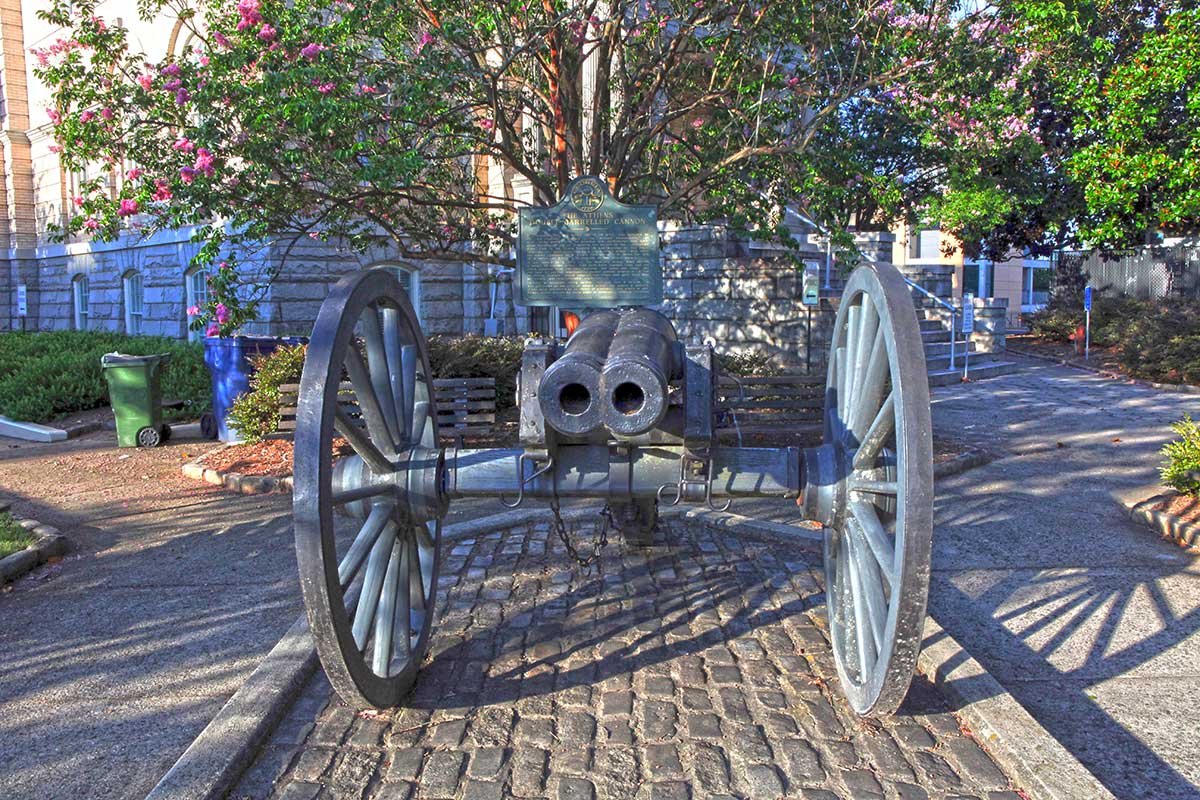
Athens, Georgia is not where you’d expect to find one of the Civil War’s most bizarre footnotes. But parked on the lawn of City Hall, twin barrels pointed permanently north, the Double Barreled Cannon has been telling its story to anyone who stops long enough to listen for over a century and a half.
The man behind it was John Gilleland — a local dentist, builder, and mechanic with a restless imagination and a fierce loyalty to the Confederate cause. In 1862, as the war ground on and Southern resources dwindled, Gilleland had an idea. A member of Athens’ home-guard militia, the Mitchell Thunderbolts, he went to his neighbors and raised $350 to fund something the Confederacy had never seen.
The concept was straightforward in theory. Two cast-iron barrels, set side by side and angled three degrees apart. Two cannonballs connected by a heavy chain. Fire both simultaneously, and the spinning chain would cut through enemy ranks — in Gilleland’s own words — “like a scythe cuts wheat.”
Cast in 1863 at the Athens Foundry and Machine Works, the weapon was an impressive piece of engineering for a town operating under wartime shortages. What it was not, as it turned out, was reliable.
The test firing along Newton Bridge Road went badly. Uneven ignition sent the chained balls careening in opposite directions. The chain snapped. The cannonballs tore through a cornfield, splintered a stand of saplings, toppled a farmer’s chimney, and — according to at least one account — killed a cow. Confederate officials, presented with this evidence, decided the weapon was too unpredictable for combat. It was sidelined.
Its only wartime use came in July 1864, when it was fired once as a signal gun to warn Athens of an approaching Union raid. The raid never materialized. The alarm was false.
After the war the cannon faded from view entirely, eventually turning up in a junk shop among forgotten relics. It was later restored and gifted to the city, taking its place on the City Hall lawn where it has remained ever since.
What makes the Double Barreled Cannon worth remembering isn’t the failure — it’s what the failure represents. Gilleland wasn’t a military engineer or a weapons manufacturer. He was a dentist who convinced his neighbors to fund a long shot because the alternative was doing nothing. The cannon is a window into the Civil War at the local level: communities scrambling, ordinary people improvising, and a town trying to protect itself with whatever it could pull together.
The war produced no shortage of grand strategies and celebrated commanders. It also produced this — two barrels, a length of chain, and a cornfield full of evidence that some ideas are better on paper.