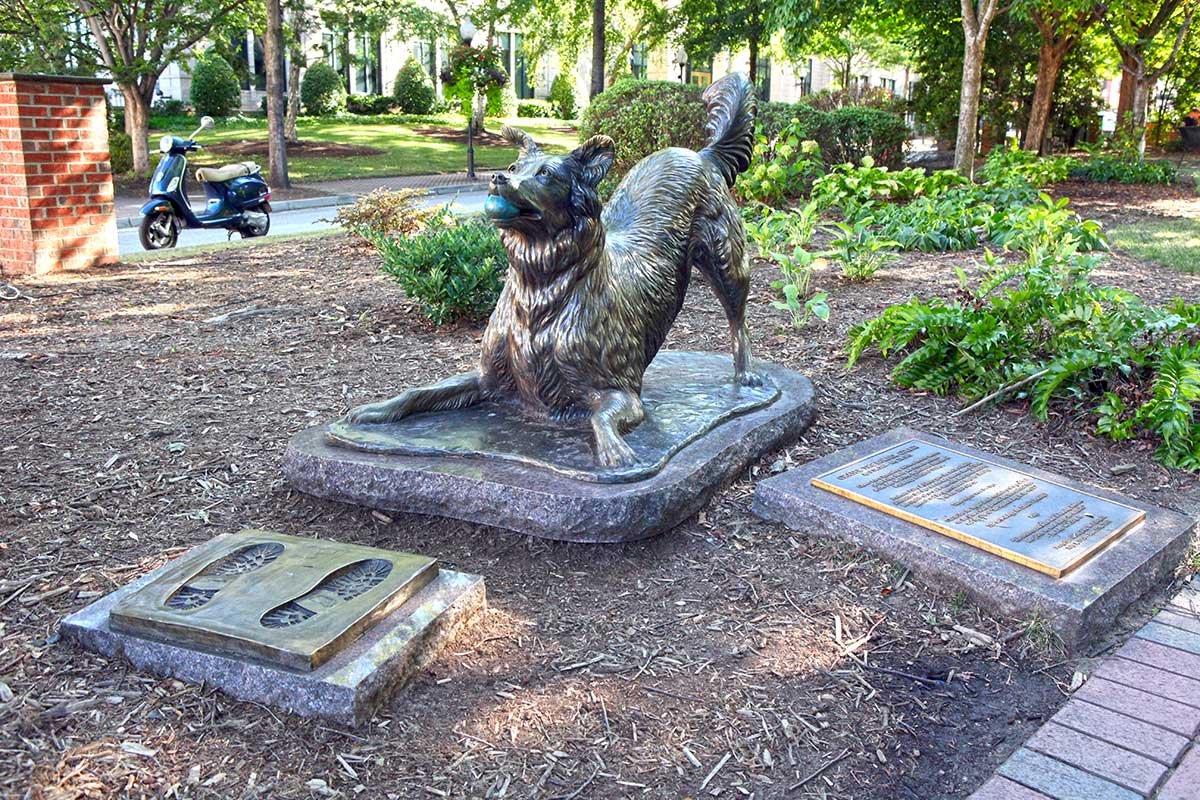
In downtown Spartanburg, South Carolina, a bronze border collie sits on permanent watch — ears up, expression alert, exactly the way people who knew her say she always looked when there was something new to learn.
The statue honors Chaser, and if you grew up with a dog and ever wondered how much they really understand, her story will stay with you.
The Professor and His Dog
Chaser came into the life of Dr. John Pilley in 2004. Pilley was a psychology professor at Wofford College in Spartanburg, a man who had spent his career thinking carefully about how minds work — human and animal alike. He had a theory that dogs were capable of far more language comprehension than the scientific community generally credited them with. Chaser became his proof.
Over years of patient, playful training built around the way dogs naturally learn through play, Pilley taught Chaser the names of her toys — hundreds of them. By the time researchers took notice, she could identify over 1,000 individual objects by name, retrieving the correct item from a pile on command with a reliability that ruled out luck or coincidence.
The scientific community paid attention. Studies were published. Chaser appeared on major television programs and in international news coverage. She became the most scientifically documented dog in history, and the research she and Pilley produced together shifted how animal cognition researchers think about the learning capacity of dogs.
What made Chaser’s ability particularly significant wasn’t just the volume of words she knew — it was the evidence that she understood something about categories and grammar. She could apply a new word to an unfamiliar object through a process of elimination, understanding that a name she hadn’t heard before must belong to the thing she didn’t already recognize. That kind of inferential reasoning had rarely been demonstrated in non-human animals.
After Chaser
Chaser passed away in 2019 at the age of fifteen. Dr. Pilley had died the year before, in 2018. The partnership that had produced so much — the long afternoons with the toy pile, the patient repetition, the publications that changed minds — was over.
Spartanburg responded the way communities do when they recognize they were home to something worth remembering. The bronze statue in downtown is a joyful piece of public art — a border collie caught in a moment of attentive stillness, the posture of a dog who is paying close attention and ready for whatever comes next.
It’s a fitting tribute to an animal who spent her life doing exactly that.