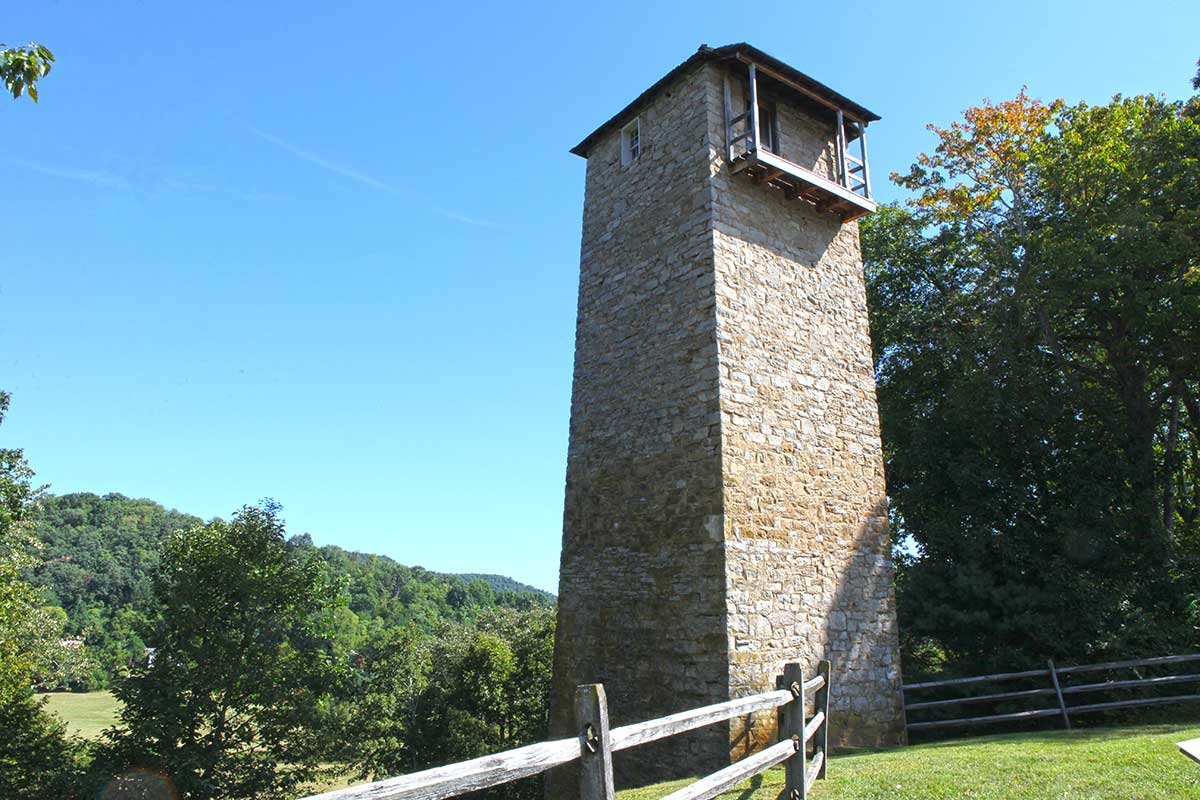
There’s a stone tower perched on a cliff above the New River in southwestern Virginia that most people drive past without knowing what they’re looking at. That’s a shame, because what happened inside it is one of the more elegant pieces of engineering the early American frontier ever produced.
The Jackson Ferry Shot Tower was built in 1807 to solve a specific problem: how do you mass-produce perfectly round musket balls in a place that is, by any measure, the middle of nowhere?
The Problem With Lead
Making ammunition on the frontier wasn’t simple. Musket balls had to be as close to perfectly spherical as possible — an irregular ball tumbled unpredictably in flight and hit nothing you were aiming at. Casting them by hand in molds worked, but it was slow, labor-intensive, and inconsistent.
Someone figured out a better way. If you melted lead, mixed in a small amount of arsenic to raise the surface tension, and dropped it from a sufficient height, gravity and physics would do the shaping for you. A falling droplet of molten metal naturally pulls itself into a sphere. All you needed was enough height — and a way to cool it before it hit the ground.
The Tower
The solution at Jackson Ferry was elegant in its simplicity and ambitious in its execution. Workers constructed a limestone tower seventy-five feet tall on a cliff edge above the river — and then kept going, carving a shaft another seventy-five feet straight down into the rock beneath it. Total drop: one hundred and fifty feet.
Lead ore from the Austinville mines nearby was hauled to the top, melted down, and poured through a sieve. The droplets fell the length of the tower, continued down through the shaft in the cliff, and landed in a kettle of water at the bottom that cushioned and cooled them. What came out were small, consistent, nearly perfect spheres — ready to load.
The limestone construction is part of what makes this tower rare. Most shot towers of the era were built from wood or brick. This one was cut from the cliff itself, which is part of why it’s still standing more than two centuries later.
What Survives
Shot Tower Historical State Park is one of the few places in the country where you can still stand inside a working piece of early American industrial history. The fires are cold now and the lead stopped falling a long time ago, but the tower itself is intact — the shaft still drops into the earth beneath it, the cliff still falls away to the New River below.
It’s a small site. An hour, maybe two. But it rewards the kind of traveler who finds something satisfying in understanding exactly how a thing worked — the logic of it, the ingenuity of people solving hard problems with the materials at hand.
On the frontier in 1807, this tower was as sophisticated as manufacturing got. Standing inside it, that’s not hard to believe.