St. Augustine, Florida was founded in 1565 — fifty-five years before the Mayflower dropped anchor at Plymouth Rock. Most Americans learn American history starting with the Pilgrims. The actual starting point is further south, older, and considerably warmer.
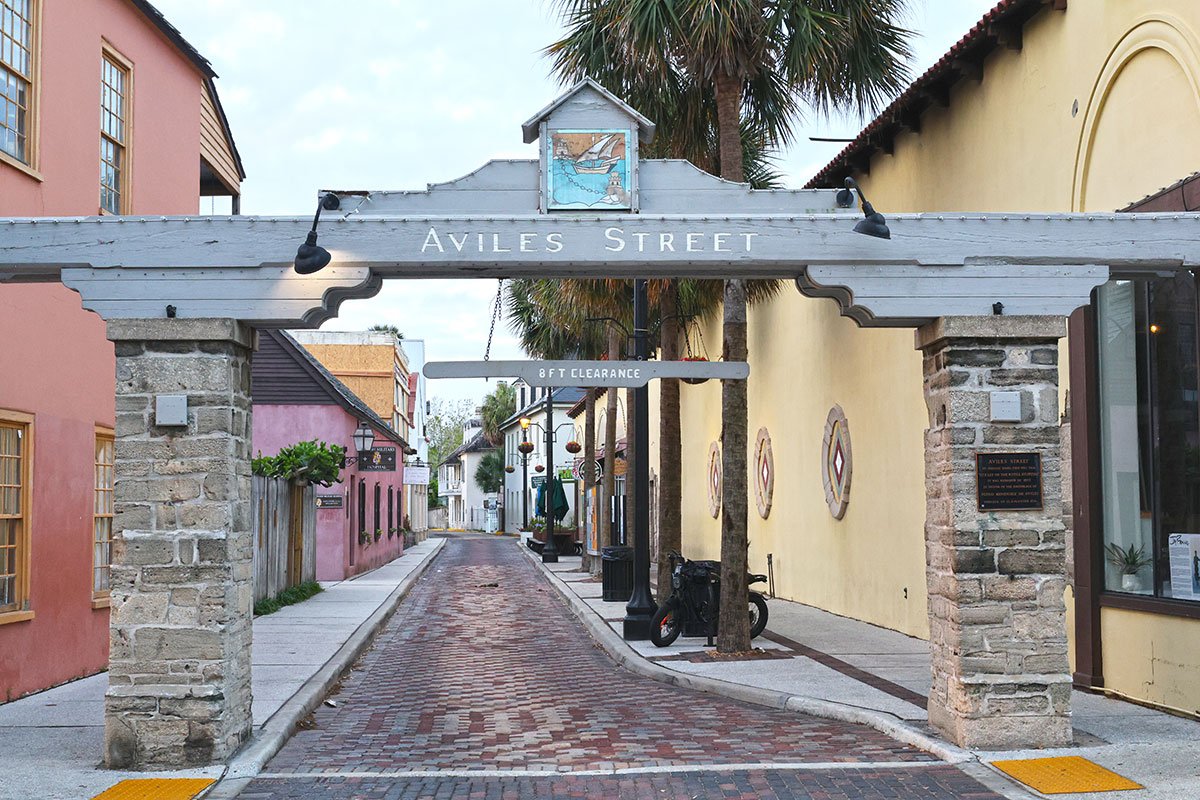
And somewhere in the middle of this oldest American city is a street so short you could walk it in two minutes without trying.
One Block, Five Centuries
Aviles Street runs for a single block in the historic heart of St. Augustine. It is widely recognized as the oldest street in the United States — a claim that sounds like tourist marketing until you do the math. The Spanish laid out this city more than half a century before the English established a permanent foothold in New England. The street grid they created, including this block, predates the United States by more than two hundred years. Most of what Americans think of as old doesn’t come close.
Three flags have flown over this street. Spain claimed it first, holding St. Augustine for over two centuries as a strategic outpost protecting the treasure fleets moving through the Florida Straits. Britain took it in 1763 as part of the settlement following the French and Indian War, held it for twenty years, and left enough of a mark that the influence is still visible in the architecture. Spain returned in 1783 and kept it until Florida passed to the United States in 1821.
Three empires. One block. A street that has been here for every chapter of this continent’s recorded history.
What the Street Has Seen
Aviles Street has absorbed the texture of every era that passed through it. The buildings that line it represent layers of construction and reconstruction across five centuries — colonial Spanish architecture, British modifications, American additions, all compressed into a single short block in a way that no museum exhibit can quite replicate.
What makes it worth lingering over is precisely what makes it easy to miss. It doesn’t announce itself. It isn’t wide or dramatic. It sits in a city that has a great deal of visible history competing for attention — the Castillo de San Marcos, the old city gates, the colonial quarter — and a visitor moving quickly through St. Augustine could walk past Aviles Street without registering what it is.
That would be a mistake.
Stand on this block and you are standing on the oldest continuously inhabited street in the country, in the oldest continuously occupied European settlement in the country, in a city that was already decades old when the first Thanksgiving happened a thousand miles to the north.
Most people drive right past it. Don’t.