At the northern edge of Charleston Harbor, where the Cooper River bends and the marshes give way to solid ground, there is a place that once employed more people than any other operation in South Carolina. Today most Charlestonians drive past it without thinking much about what happened there. That’s worth correcting.
This is the Charleston Naval Base. And it was, for most of the twentieth century, a city unto itself.
How It Started
The Navy arrived on the bones of Chicora Park in 1901, starting modestly — repairing tugboats, painting hulls, taking on the unglamorous maintenance work that keeps a fleet operational. The ambitions that followed were anything but modest.
Dry Dock Number One, completed in 1907, was one of the largest capacity dry docks on the East Coast when it opened. Twelve years later, the Yard launched its first destroyer, the USS Tillman, from these waters. The transformation from repair depot to full shipbuilding operation had taken less than two decades.
Dry Dock Number Two tells a different chapter. Completed in 1942 as the country entered World War II, it was built specifically to service the destroyers that would hunt German U-boats in the Atlantic. Two decades later, it was lengthened and reinforced to accommodate something newer and quieter: nuclear-powered ballistic missile submarines. The same concrete walls that supported the war against the Axis eventually sheltered the arsenal of the Cold War.
The City Within a City
World War II transformed the Yard into something that defies easy description. The workforce swelled to nearly 26,000 people working around the clock. It was the largest employer in the state, and for the men and women who worked there, it was less a job site than a world.
They didn’t just build ships. They sustained the fleet in ways that don’t make it into the history books — taking battle-damaged cruisers that limped into harbor with exhausted crews and scarred hulls and making them whole again in days or weeks, then sending them back out to sea. Over the course of the war, the Yard serviced more than 1,350 vessels.
They did this work under genuine threat. The glow of a welder’s arc was a visible beacon to the U-boats known to be operating offshore. The Yard worked under blackout conditions, the stakes of every shift measured in Atlantic convoys and the lives aboard them.
When the whistle blew, many workers didn’t go home to another part of the city. They went home to the Yard. The nearby suburb of Park Circle — now one of Charleston’s most popular neighborhoods — was originally one of the first modern planned communities in South Carolina, built specifically to house shipyard workers and their families.
Officers’ Row and the Architecture of Command
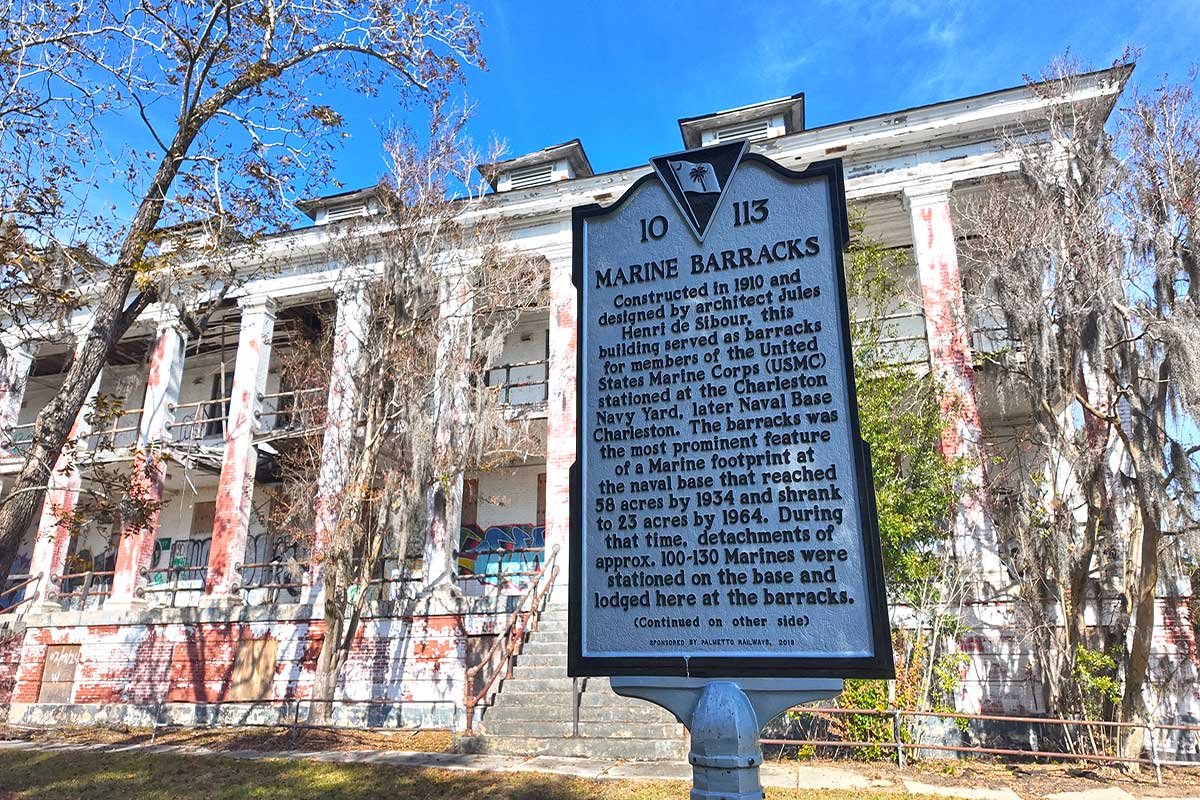
The residential and administrative heart of the Yard was Officers’ Row, a stretch of historic buildings that still stands today. Quarters A — the Admiral’s House — was where strategy sessions happened, where decisions were made that sent ships and men to every ocean on the globe. Quarters H-I, built in the Italian Renaissance Revival style, served as administrative headquarters. Down the street, the Marine Barracks housed generations of young men for whom these walls were their first home in the service.
The Yard also had its own hospital, growing from a makeshift medical facility in 1917 to a permanent complex, and finally in 1973 to the stark brutalist tower of the Naval Regional Medical Center — a building considered so architecturally innovative it won awards.
The Closing
By the 1970s and 80s, the calculus had changed. The Cold War was winding down. New technologies made a yard of this scale harder to justify. In 1996, after nearly a century of continuous operation, the gates swung shut for the last time.
What It’s Becoming
The story didn’t end there. The old machine shops that once roared with the sound of forges building torpedo parts now house tech companies, offices, and apartments. The dry docks that serviced World War II destroyers operate today as commercial shipyards. The historic officers’ quarters have been preserved and repurposed as event spaces, their original bones intact.
The Charleston Navy Yard is a living manuscript — a place that has been written on, erased, and written over again, without ever quite losing what came before. The concrete is the same concrete. The river is the same river. The story just keeps going.