Before Florida was beaches and theme parks and six-lane highways, it was something else entirely. The southern tip of the state is still dominated by one of the largest wetlands in North America — a slow-moving river of grass stretching in every direction, flat and dense and disorienting, where the air smells of mud and salt and decay, and where sound travels in ways that don’t quite make sense.
This is the landscape that produced the Skunk Ape. And understanding the legend requires understanding the place first.
A Landscape Made for Hiding
Everglades National Park alone protects 1.5 million acres of wilderness — an area larger than the entire state of Delaware. But it isn’t one open marsh. It’s a maze of cypress domes, mangrove tunnels, and palmetto scrub so dense you can lose your bearings within minutes of leaving a trail.
Search and rescue teams know this intimately. In 2015, a hiker went missing near the Anhinga Trail. Helicopters flew overhead. GPS marked his last known position. It still took searchers four days to find him, less than half a mile from where he’d started. Visibility is short. Landmarks repeat. Water erases tracks within hours.
Black bears, Florida panthers, and alligators longer than pickup trucks move through this landscape largely unseen. If something wanted to stay hidden here, it wouldn’t be the first.
The Early Accounts
The oldest written reference to something unusual in South Florida’s swamps may be an 1818 letter from a surveyor working near the Caloosahatchee River, who described his Seminole guides refusing to enter certain areas — places they said belonged to a wild man who walks like smoke. Whether that referred to a spiritual belief, a territorial warning, or something else, the surveyor couldn’t say. He noted only that his guides were serious.
By the late 1800s, as settlers, hunters, and trappers pushed deeper into the region, similar stories began appearing in personal accounts. Something large crashing through brush at night. Livestock disturbed. Strange tracks pressed into soft mud. In 1942, the Naples Daily News printed a brief item about hunters near Collier-Seminole State Park reporting an animal of unusual size walking on two legs. Throughout the 1950s and 60s, small-town papers across South Florida occasionally noted calls to sheriffs’ offices — a hairy man near the road, something screaming in the woods, a large animal walking upright. Almost always dismissed. Almost always unexplained.
The Name
The nickname came from something witnesses mentioned repeatedly — not just what they saw, but what they smelled. A powerful, lingering stench. Rotten eggs. Wet fur. Stagnant water. The kind of odor that clings to the air long after the source has moved on. Hunters compared it to a skunk, but bigger and stronger. Skunk Ape wasn’t scientific or official. It was just what locals started calling it. By the early 1970s, the name had stuck.
The Sighting Wave
Between 1970 and 2000, Florida’s population more than doubled, from 6.7 million to over 15 million people. New subdivisions pushed closer to wilderness. Interstate 75 — Alligator Alley — cut straight through the heart of the Everglades in 1968. More people meant more eyes on the tree lines, more drivers on the roads at night, more campers in the backcountry.
In 1974, the Fort Myers News-Press ran a feature on multiple sightings near Fakahatchee Strand. Local police investigated, found no suspect, and photographed large humanoid tracks pressed into soft ground near a drainage canal. Wildlife officers suggested bear. Witnesses insisted otherwise.
The reports kept coming. So consistently that in 1977, Florida state Representative Paul Nuckolls introduced legislation to formally protect the creature, targeting what the bill called anthropoid or humanoid animals and making it a crime to harm or capture one. It never passed. But the fact that it was introduced at all says something about how seriously some communities were taking the reports.
The Myakka Photographs
For roughly two decades the Skunk Ape returned to the shadows. The stories didn’t stop — they just got quieter.
Then in 2000, an anonymous letter arrived at the Sarasota County Sheriff’s Office. Inside were two photographs. The writer explained that her elderly mother had taken the pictures in her backyard near Myakka River State Park, where something had been raiding her apple basket at night. When she investigated one evening, she saw it.
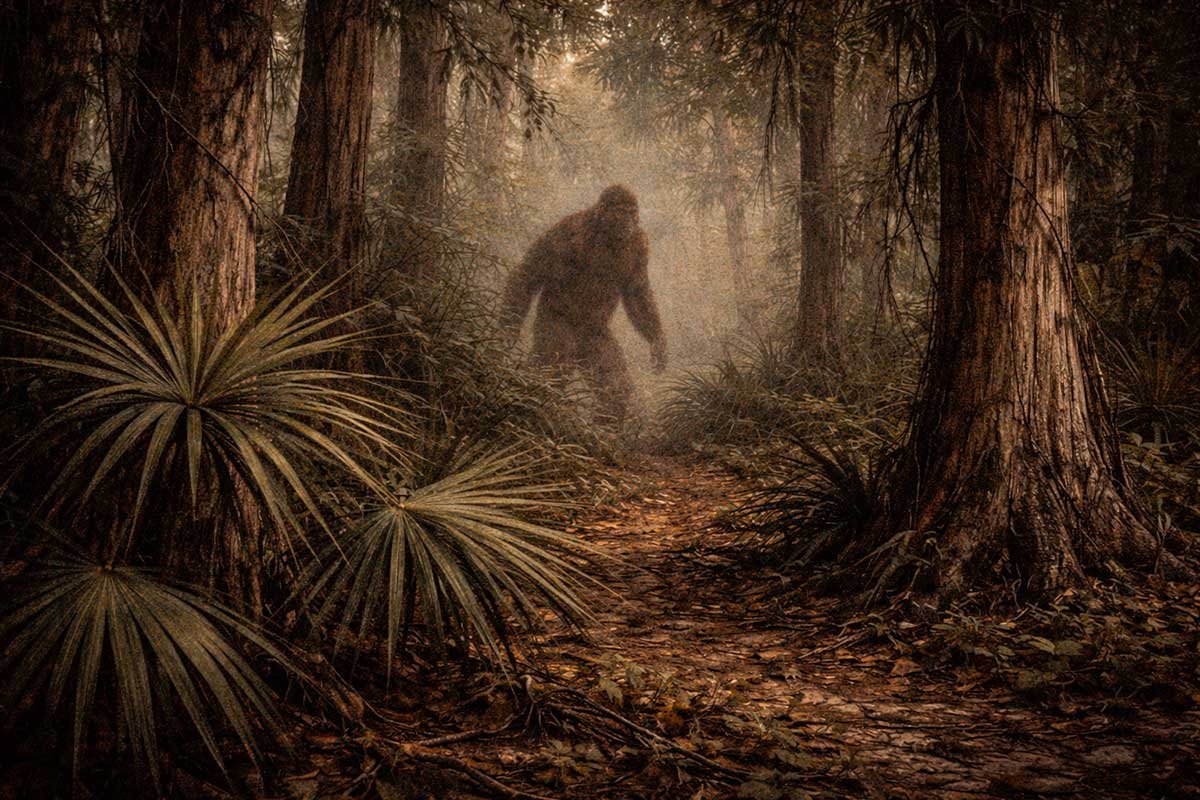
The photographs show a large, dark figure crouched among palmetto fronds. Broad shoulders. Long arms. A body covered in hair. The face obscured by shadow and distance. The images are blurry — shot at night with what appears to be a cheap camera — but unlike typical hoax photographs, there’s no clear pose, no obvious costume seam, just a bulky shape partially hidden in vegetation.
The sheriff’s office released the photos publicly. Wildlife experts offered explanations: a black bear foraging, an escaped chimpanzee, possibly an orangutan, though none were reported missing in Florida. Others argued the proportions were wrong — the figure too large, the arms too long. The photographs were never conclusively explained. But they moved the Skunk Ape from local folklore into a national conversation.
What Science Says
Biologists tend to be cautious, and the explanations they offer are well-documented. Florida black bears can weigh over 400 pounds, and when they stand upright to sniff the air they look surprisingly human from a distance. Wild hogs produce screams that sound disturbingly like a person in distress. Wetlands constantly release methane and sulfur gases as organic matter decays — a sudden pocket of that air can be overwhelming. Combine low light, dense vegetation, and isolation, and the brain begins assembling shapes that aren’t there. It’s a phenomenon called pareidolia, and it accounts for a significant portion of reported sightings.
But not all of them. Some reports — multiple witnesses, clear conditions, detailed descriptions — resist easy dismissal. It’s in that small margin of uncertainty where legends survive.
Why the Legend Matters
The Skunk Ape isn’t unique. The Pacific Northwest has Bigfoot. The Himalayas have the Yeti. Louisiana’s swamps have the Honey Island Swamp Monster. Every major wilderness seems to generate one. Anthropologists suggest these stories serve a function — they mark boundaries, express our unease with the wild, and remind us that not everything is mapped and cataloged and controlled.
In Florida’s case, the timing is significant. The Skunk Ape legend solidified just as the Everglades faced unprecedented development pressure — as wetlands were drained, as highways carved through habitat, as wilderness shrank. The legend may have grown precisely because people needed it to. A way of saying that something still lives here that we don’t understand. Something that belongs. Something we haven’t conquered.
No bones have been found. No hair samples confirmed. No animal captured. Just decades of reports passed from ranger to ranger, hunter to hunter, neighbor to neighbor. For some, that’s enough to dismiss it entirely. For others, it’s enough to wonder.
Because out here, the trees block the horizon, the water swallows sound, and once the sun goes down you can only see a few feet in any direction.
Something out there might see much farther.