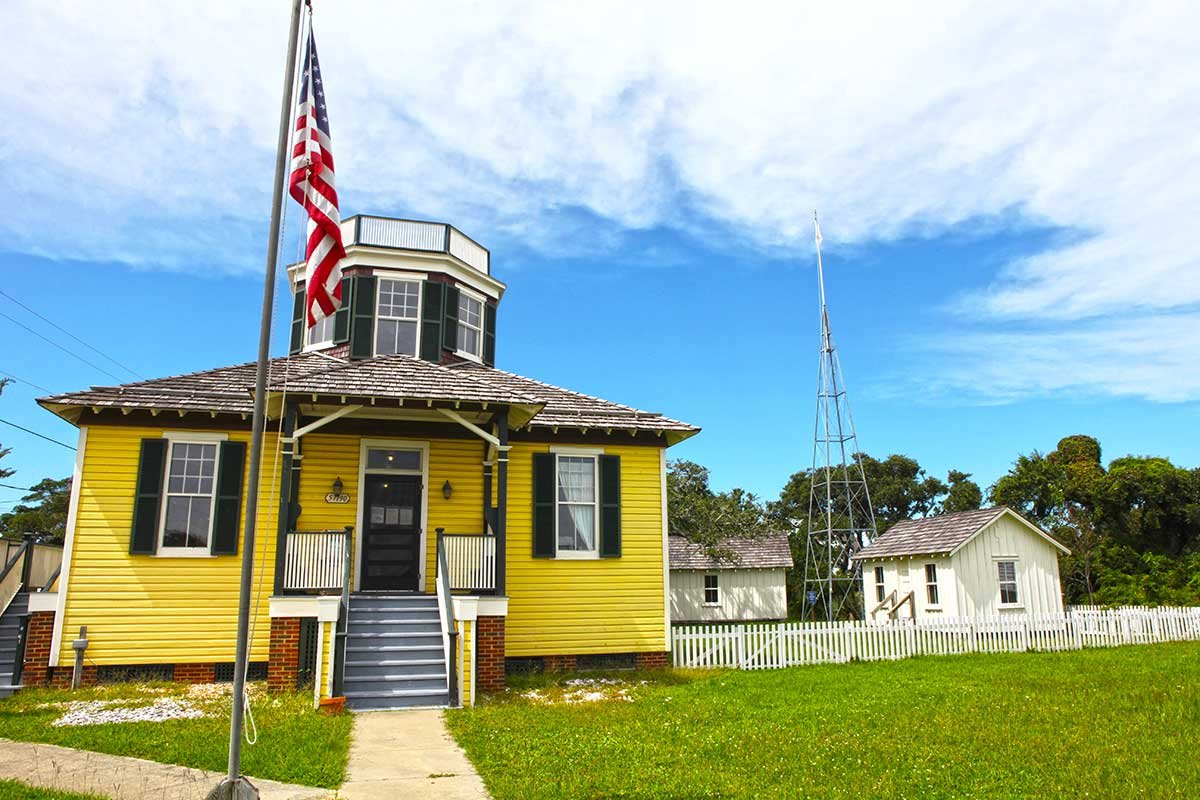
In Hatteras Village on the Outer Banks of North Carolina, there is a small yellow building that most people drive right past. That’s understandable. It doesn’t announce itself. It sits quietly on the edge of a village that most visitors pass through on their way to the ferry or the lighthouse, and nothing about its appearance suggests that anything remarkable ever happened inside it.
But on the night of April 14, 1912, two operators at the Hatteras weather station — Horace Gaskins and Richard Dailey — received a message from the RMS Titanic.
“Have struck iceberg.”
Why Hatteras Mattered
The station wasn’t there by accident. Hatteras Island occupies one of the most strategically significant positions on the Eastern Seaboard — a narrow strip of barrier island jutting into the Atlantic at the point where the cold Labrador Current meets the warm Gulf Stream, creating weather patterns that have shaped and ended the lives of mariners for centuries. The waters off Cape Hatteras earned the name Graveyard of the Atlantic for reasons that are still visible today in the wrecks that lie just offshore.
The U.S. Weather Bureau understood what that location meant for coastal forecasting. In 1901, they constructed a dedicated weather station building in Hatteras Village — one of only eleven such purpose-built structures erected across the entire country at the turn of the century. Observers here recorded data hourly: barometric pressure, humidity, rainfall, temperature, and wind speed, feeding a coastal forecasting network that protected mariners and communities the length of the Eastern Seaboard.
It was serious, unglamorous, essential work. The kind that doesn’t make history until something extraordinary happens in the middle of an ordinary night shift.
April 14, 1912
The Titanic struck the iceberg at 11:40 p.m. ship’s time. In the hours that followed, as the ship’s operators sent distress signals into the Atlantic night, one of those signals reached the small yellow building in Hatteras Village, where Gaskins and Dailey were on duty. They received the message, logged it, and passed it along — two men at a weather station on a barrier island in North Carolina, briefly connected to one of the most catastrophic nights in maritime history.
It is the kind of moment that history generates constantly and mostly forgets. A small node in a larger network, doing exactly what it was built to do, on a night when it mattered more than usual.
What Survives
The station operated until 1946. In the decades that followed, most of what the Weather Bureau built at the turn of the century disappeared — replaced, demolished, or altered beyond recognition. The Hatteras building survived, and the National Park Service eventually restored it to its original 1901 appearance.
It is now the only U.S. Weather Bureau station in the country that still looks exactly as it did when it was built. It serves today as a welcome center for Hatteras Village — open, accessible, and easy to miss if you don’t know what you’re looking at.
Which is part of what makes it worth stopping for. Some history announces itself with monuments and markers. Some of it just sits quietly by the road in a small yellow building, waiting for someone to notice.