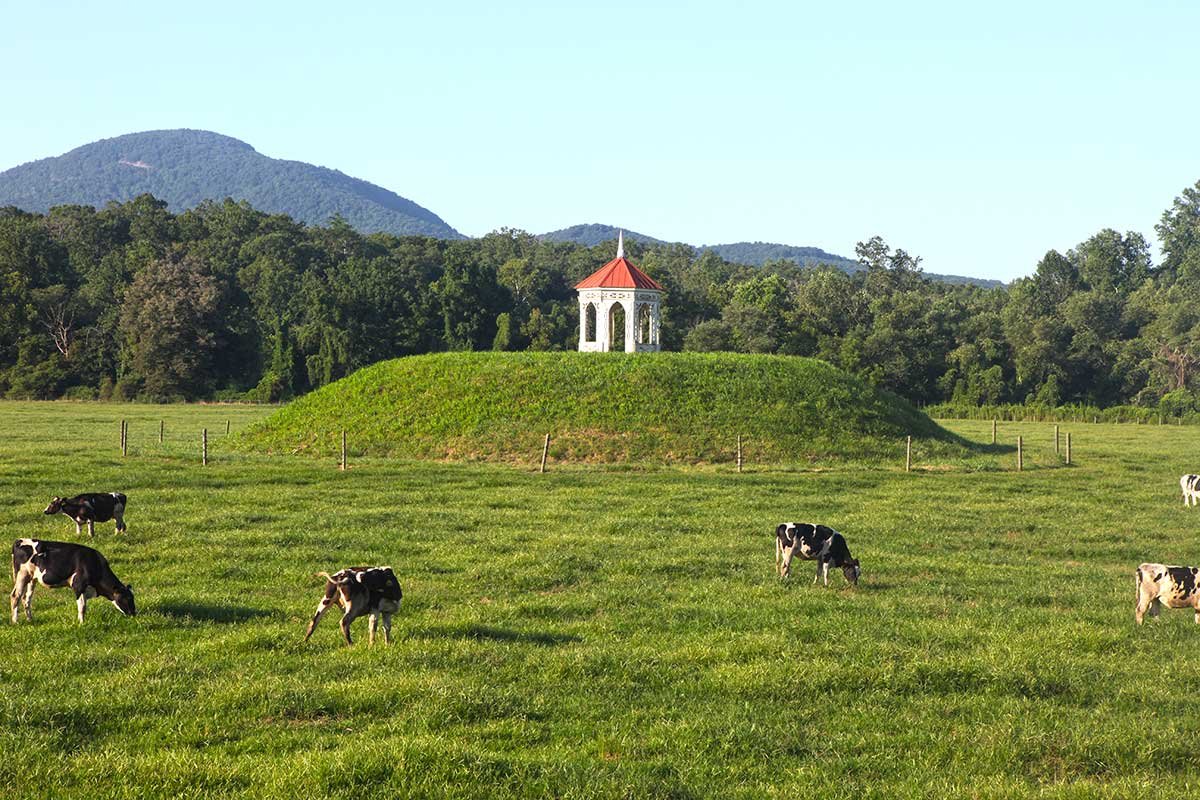
Most people who drive through Georgia’s Nacoochee Valley on their way to the mountain town of Helen notice the white gazebo first. It sits on top of a grass-covered hill in the middle of a pastoral valley, framed by mountains, pretty in the way that decorative follies in old estate gardens are pretty. It looks like someone’s idea of a charming landscape feature.
That’s because someone made it one. But the hill itself is something far older.
What the Mound Is
The Nacoochee Mound was built by Mississippian peoples between approximately 1350 and 1600 CE as a ceremonial platform and burial site. The Mississippian culture was one of the most sophisticated in pre-Columbian North America — a society of large, organized towns built around platform mounds that served as elevated foundations for temples, council houses, and the homes of political and religious leaders. Their influence extended across much of the Southeast, and the mounds they left behind remain some of the most significant archaeological landmarks in the region.
The Nacoochee Mound sits in a valley that would have been ideal for settlement — fertile bottomland, a reliable river, surrounded by mountains that provided both resources and natural boundaries. The people who built it chose this location deliberately, and the mound they constructed rose to dominate the valley floor in ways that the gazebo now echoes without meaning to.
What the Excavations Found
In 1915, archaeologists excavated the mound and documented 75 burials along with a significant collection of artifacts — pottery, tools, ornamental objects — that confirmed the sophistication of the society that built it. The excavation followed the methods of its era, which were less careful than modern archaeological standards would require, but what was recovered provided substantial evidence of a complex and well-organized culture that had called this valley home for centuries before European contact.
The mound was reconstructed in the early twentieth century, and the gazebo that now sits at its summit was added in 1890, when the surrounding land was part of a private estate. The result is one of those peculiar American historical layerings — an ancient ceremonial site wearing a Victorian garden ornament like a hat — that somehow works as a landmark even as it complicates the history.
The Legend
The valley’s name carries its own story. Local legend tells of Sautee and Nacoochee, young lovers from rival Cherokee and neighboring tribes whose families opposed their relationship. According to the legend, discovered together after a fatal plunge from the surrounding cliffs, they were buried side by side beneath the mound, hand in hand. The nearby town of Sautee and the valley itself take their names from this story.
Like most such legends, it exists at the border between history and wish — a romantic explanation attached to a real place that needed a human story to match its gravity. Whether the story is old or invented, it has become part of how this valley understands itself.
Hardman Farm Today
The mound is preserved today as part of Hardman Farm State Historic Site, the historic estate that surrounds it. It sits quietly beside the road at the valley floor, watched over by the mountains that have been there longer than the mound, the gazebo, the legend, or anyone alive to see any of them.
Pull over and stand next to it for a moment. The valley is genuinely beautiful, and the mound gives that beauty a depth that the scenery alone doesn’t provide. Something was built here with intention and care, by people who understood this landscape in ways we can only partially recover. That’s worth a few minutes of attention.