Deep in South Carolina’s Lowcountry, set back from a quiet road beneath a canopy of moss-draped oaks, stand the walls of a church that has been destroyed twice and is still standing.
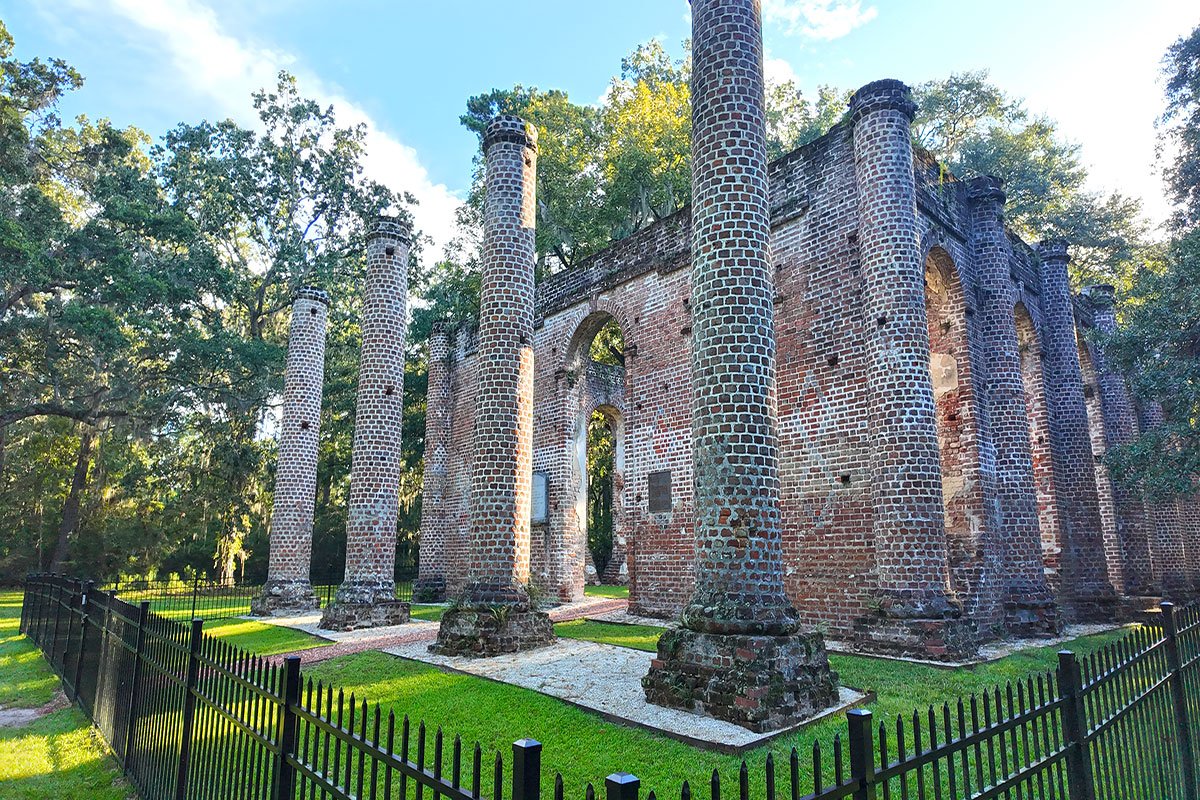
That’s not a metaphor. The walls are literal — thick brick shells open to the sky, roofless and empty, the windows long since reduced to graceful arched frames through which light and Spanish moss and the sounds of the surrounding woods now pass freely. Sheldon Church has been a ruin for longer than most American buildings have existed at all, and it remains one of the most quietly stunning places in the South.
What Was Built Here
Prince William’s Parish Church — known today as Old Sheldon Church — was constructed in the mid-1700s, and what its builders attempted was unusual for colonial America. This was one of the earliest deliberate efforts in the country to evoke the form of a Greek temple in brick and mortar: a portico of thick columns, a classical symmetry, an architectural ambition that looked to ancient precedent in a landscape that was still very much a frontier. It was a statement about permanence and civilization in a place where neither was guaranteed.
The walls were built three feet thick. That decision, made by builders who could not have known what was coming, is the reason anything is still standing today.
Burned Twice
The British burned Sheldon Church in 1779 during the Revolutionary War. It was not a random act of destruction — the church had become a symbol, and the burning was deliberate. What the fire left behind were those three-foot walls, which proved more durable than anyone who ordered the burning had apparently anticipated.
The congregation rebuilt using what remained. The original walls were incorporated into the reconstructed church, a decision that gave the building a layered history even before its second destruction. That came during the Civil War era, when Sherman’s forces moved through the Lowcountry and the church burned again. This time it was not rebuilt. The walls that had survived two fires and nearly a century of South Carolina summers were left as they stood, and left as they stand still.
What Remains
What survives is something that functions as both ruin and sanctuary. The roofless shell frames an open-air space where sunlight falls through the window arches and across the original brick floor. Ancient oaks press close on all sides. The silence is the particular silence of a place that has absorbed a great deal of history and is no longer in a hurry about anything.
Old Sheldon Church sits outside Yemassee in Beaufort County, and it draws a steady stream of visitors who come for the atmosphere and tend to leave with something harder to name. There is a beauty to ruins that have been left alone — not restored, not repurposed, simply allowed to exist in their broken state — and Sheldon Church is among the finest examples of that particular beauty anywhere in the American South.
Some things get built to last. These walls were among them.