There is a mountain six miles from Chattanooga, Tennessee, where 300-million-year-old sandstone formations rise into narrow corridors and open suddenly onto views that stretch across the horizon. It is a genuinely remarkable piece of geology. It is also one of the most brilliantly marketed tourist attractions this country has ever produced, and understanding Rock City requires holding both of those things at once.
Frieda’s Mountain
In the 1920s, entrepreneur Garnet Carter and his German-born wife Frieda bought land on Lookout Mountain with vague plans for development. Garnet was a natural promoter — he would later popularize miniature golf as a way to rescue a failing course — but it was Frieda who saw what the mountain actually was.
She walked the cliffs and gorges for years, weaving footpaths through the ancient sandstone, planting thousands of native flowers and shrubs, turning what anyone else might have seen as obstacles into the bones of a storybook landscape. She called it Rock City. The name was hers. So was the vision.
They opened to the public in 1932, at the absolute depth of the Great Depression. The challenge was immediate and obvious: how do you persuade people to drive up a mountain in the hardest economic times in living memory, to look at rocks?
The Barn Campaign
Garnet’s answer became a piece of American marketing folklore.
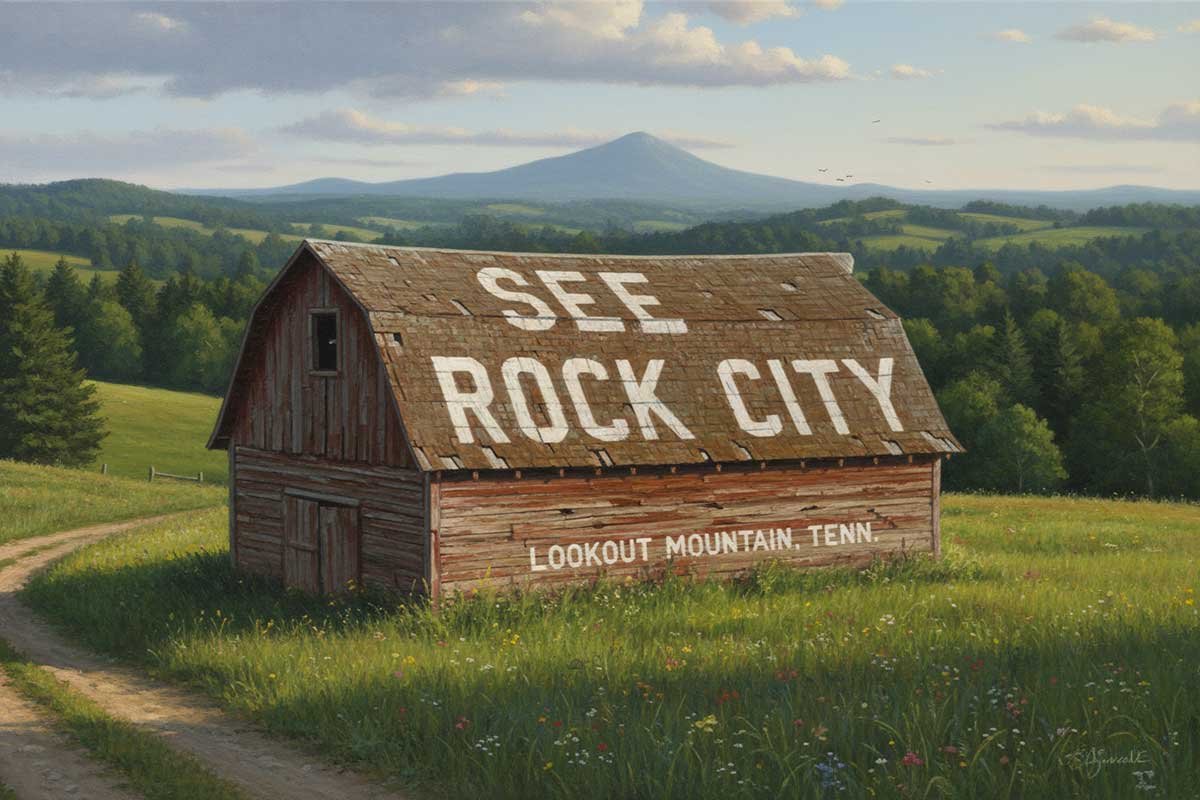
He hired a young painter named Clark Byers and sent him south with a simple proposition for farmers along the region’s highways: a free paint job for your weathered barn, in exchange for three words on the roof or the side. The words were SEE ROCK CITY, painted in bold white block letters visible from the road.
The arrangement worked for everyone. Farmers got their barns painted at no cost. Rock City got a billboard that couldn’t be ignored, couldn’t be moved, and required no ongoing fees. And Byers spent years driving the back roads of the South, turning the landscape itself into an advertisement. At the campaign’s peak, more than 900 barns across 19 states carried the message — an inescapable presence on every road trip through the Southeast for a generation of American travelers.
It was cheap, scalable, and utterly effective. People who had never heard of Rock City had seen the signs on every other barn between home and wherever they were going, and eventually curiosity won out over Depression-era thrift.
What You Find When You Get There
Frieda’s Enchanted Trail winds through the sandstone formations in a way that feels genuinely designed by someone who had absorbed too many fairy tales in the best possible sense — half nature, half storybook illustration. The path moves through narrow rock corridors, beneath overhanging formations, past gardens that have been tended for nearly a century.
Fat Man’s Squeeze is exactly what it sounds like: a gap in the rock that requires visitors of a certain dimension to turn sideways and commit. Lover’s Leap is the cliff where legend places a Cherokee maiden named Nacoochee, who according to the story jumped after losing a forbidden lover — the same legend attached to the Nacoochee Valley in Georgia, which says something about how mountain legends travel.
From Lover’s Leap, Rock City makes its most famous claim: that on a clear day you can see seven states — Tennessee, Georgia, Alabama, Kentucky, Virginia, North Carolina, and South Carolina. Whether the geometry of that claim holds up under scrutiny is a subject of ongoing debate. The view is spectacular regardless.
Then there are Fairyland Caverns. Deep inside the mountain, Frieda’s vision reaches its most concentrated and genuinely strange expression: a black-lit underground world of glowing Mother Goose dioramas, storybook scenes preserved in amber and neon, utterly unlike anything else in America. It is nostalgic and kitsch and somehow completely sincere, which is what makes it work.
What Rock City Is
Nearly a century after Frieda walked those first footpaths through the sandstone, Rock City remains exactly what it set out to be: a place where ancient geology and one woman’s fairy-tale imagination met and produced something that neither would have managed alone. The Depression-era determination that launched it. The barn campaign that spread it across nineteen states. The Fairyland Caverns that preserved its strangest, most genuine self.
The most memorable places aren’t always the most polished. Sometimes they’re simply the ones with the best stories.
See Rock City.