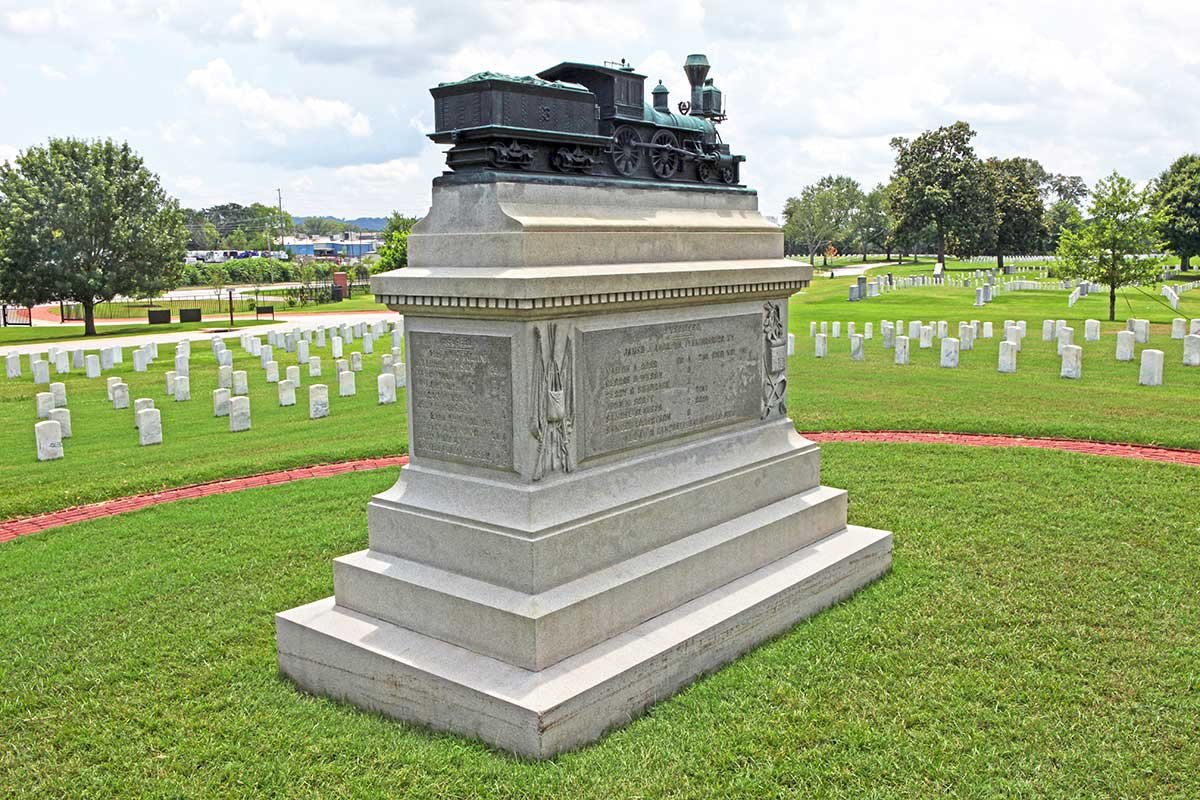
In a quiet corner of Chattanooga National Cemetery, among the orderly rows of white markers that stretch across the grounds, there is a monument unlike anything else in America. At its peak, a bronze locomotive surges forward, frozen in motion, going nowhere and everywhere at once.
It honors twenty-two men who stole a train, ran it deep into Confederate territory, and nearly changed the course of the Civil War in a single morning.
The Plan
The spring of 1862 found the Union war effort grinding through the difficulty of fighting in the South’s backyard. James J. Andrews — a civilian spy operating behind Confederate lines — brought a proposal to Union command that was either visionary or suicidal, depending on your temperament. He would lead a small team of volunteers deep into Georgia, steal a Confederate locomotive, and use it to tear up the rail lines, burn bridges, and cut telegraph wires along the Western and Atlantic Railroad — the critical supply artery feeding Confederate forces in the region. Cripple that line, and the rebel army defending Chattanooga would be strangled.
Twenty-two men volunteered. Twenty were Union soldiers; two, including Andrews himself, were civilians. All of them disguised themselves and made their way separately to Marietta, Georgia, boarding a northbound train on the morning of April 12, 1862, as ordinary passengers.
The Theft
At Big Shanty — a stop within plain sight of a Confederate training camp — the passengers stepped off for breakfast. Andrews and his men did not. They uncoupled the locomotive, a steam engine called The General, and roared north. Behind them, they cut telegraph wires and dropped railroad ties across the tracks, buying themselves time to reach the bridges they planned to burn.
They were certain they had left their pursuers behind. They had not counted on William Fuller.
The Chase
The General’s conductor refused to accept what had just happened to his train. Fuller set off in pursuit on foot, then commandeered a handcar, then found a series of locomotives as he moved north — finally boarding the engine called The Texas and driving it at full speed, in reverse, for much of the chase. The image of it is almost cinematic: a locomotive running backwards through a Georgia rainstorm, its conductor refusing to give up, closing the gap mile by mile.
What followed was seven hours of pursuit through pouring rain, with the Raiders a few desperate minutes ahead of a man who simply would not stop. They tried to drop burning boxcars behind them to slow the Texas. The rain extinguished the fires. They tried to hold bridges long enough to burn them. Fuller kept coming.
Just miles from the safety of Union lines, The General ran out of wood and water. The Raiders abandoned the engine and scattered into the Georgia woods. Every single one of them was captured.
The Executions
The Confederates made a clear determination: these men were spies, not soldiers. Andrews and seven of his men were hanged in Atlanta. The rest were imprisoned. Some staged a breakout and escaped; others waited for a prisoner exchange that eventually came. Of the twenty-two who boarded that train in Marietta, the war would not be kind to most of them.
The mission failed in its immediate objectives. The bridges were not burned. The rail line was not severed. Confederate forces held Chattanooga.
And yet the Raiders became something. Congress authorized the Medal of Honor specifically for surviving members of the raid — making them among the first recipients of what would become the nation’s highest military honor. Andrews himself, as a civilian, was ineligible.
The Monument
The Andrews Raiders Monument was erected in 1890 in Chattanooga National Cemetery, where eight of the executed Raiders were reburied nearby. The bronze locomotive at its peak was not chosen arbitrarily — it is the specific engine of the specific story, the image that carries everything: the audacity of the plan, the momentum of the chase, the moment before everything ran out.
History is shaped by vast armies and sweeping campaigns, and also by twenty-two men who sat on a northbound train in Georgia and waited for a breakfast stop.