Since 1842, South Carolina’s storied military college has shaped citizen-soldiers — testing them, breaking them down, and building them back stronger.
In the heart of historic Charleston, South Carolina, stands a landmark of discipline, honor, and leadership — one that has endured civil war, closure, resurrection, and nearly two centuries of transformation without losing the thread of its founding purpose. The Citadel, The Military College of South Carolina, is not simply a place of higher learning. It is an institution shaped by the South’s most turbulent chapters, and one that continues to shape the people who pass through its gates.
Founded in 1842, The Citadel traces its origins to a time of deep civic unrest. Following the discovery of Denmark Vesey’s planned slave rebellion, South Carolina established state arsenals in Charleston and Columbia to maintain order and military readiness. By 1843, those arsenals had evolved into something more enduring: a military academy designed to train citizen-soldiers capable of defending state and nation alike.
“The past is not preserved behind glass — it is challenged, earned, and lived by every cadet, every single day.”
From the outset, the mission was rigorous — a deliberate fusion of academic rigor and character development. But The Citadel’s resilience would face its first great test before the school had even found its footing. In January 1861, Citadel cadets stationed on Morris Island fired upon the federal supply ship Star of the West, sending a warning shot that echoed far beyond Charleston Harbor. Historians widely regard it as the first hostile act of the Civil War.
Closure and Rebirth
When the war ended in defeat for the Confederacy, the college was shuttered — silent for seventeen years. It was a long dormancy, but not a death. In 1882, the Long Gray Line was reborn, rising from those years of quiet with renewed purpose. In the decades that followed, Citadel graduates answered the nation’s call in every major American conflict, from the trenches of World War One to the mountains of Afghanistan.
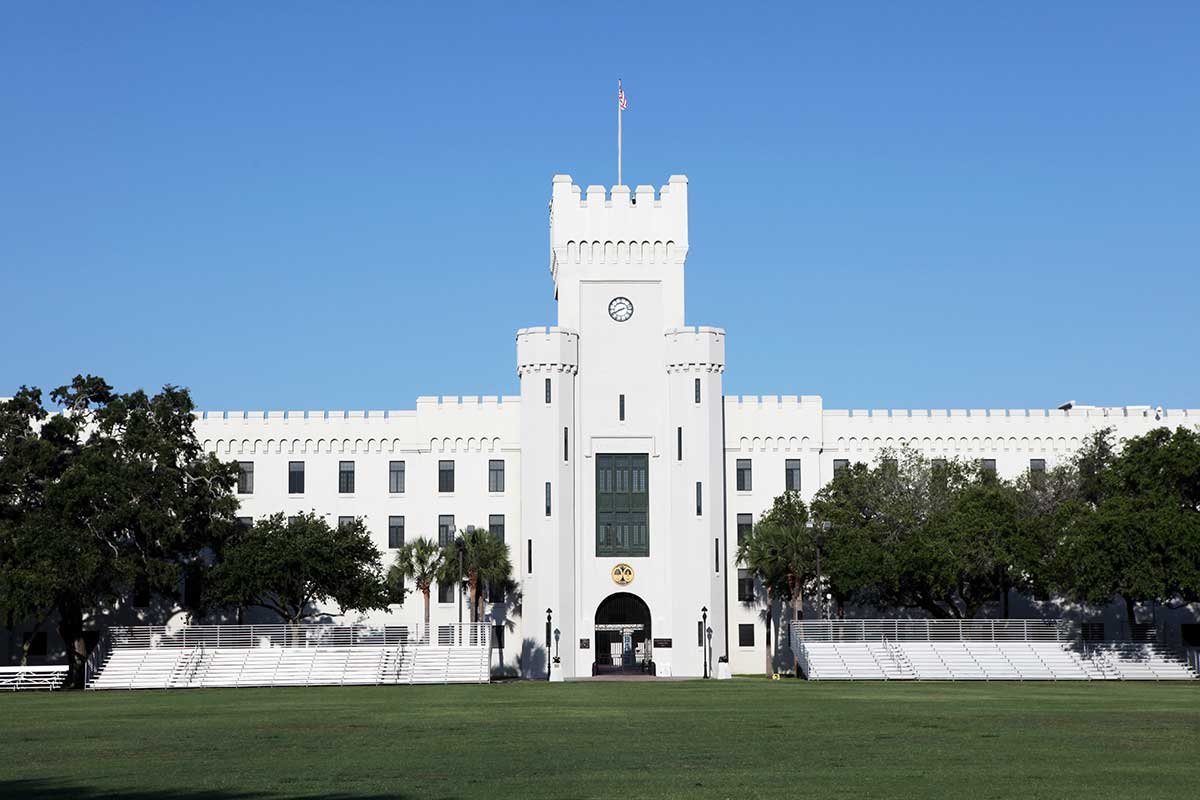
In 1922, the academy made a defining physical move to the banks of the Ashley River. The new campus was fortress by design — Spanish Moorish architecture conceived to evoke a fortified military post, complete with crenellated towers and arched colonnades. At its center stands Padgett-Thomas Barracks, its red-checkered quadrangle remaining one of the most recognizable sites in the American military world.
Forging the Long Gray Line
Today, The Citadel is one of America’s six senior military colleges. The South Carolina Corps of Cadets — now numbering around 2,300 — lives under a structured military system designed with a single long-term goal: the development of principled leaders ready for whatever comes next.
It begins with Knob Year — the demanding freshman experience that defines life at The Citadel for every entering student. The name comes from the shaved heads cadets are required to maintain. The experience itself is something more: a deliberate process of breaking down individual ego to forge something tougher and more durable in its place. Cadets rise before dawn for formations, pursue demanding degrees in engineering, business, and the sciences, and learn — often through discomfort — that true leadership is rooted not in rank, but in service.
“This is a campus built like a fortress. A history written in resolve.”
A Living Monument
The Citadel has evolved considerably since those antebellum origins. It opened its doors to women in the mid-1990s — a change that came only after a federal court battle that reached the nation’s attention — and has steadily expanded its academic reach and global alumni network. Yet its physical presence still speaks directly to its founding character. Walk the quad on any given morning, and the institution’s weight is immediately felt.
This is a place where history is not curated for visitors. It is not displayed in frames or recounted in plaques alone. It is pressed into the daily routine of every cadet who wears the uniform, endures the year of knob life, and earns the right to stand in formation beneath those Moorish towers. At The Citadel, the past is not something you study — it is something you carry.