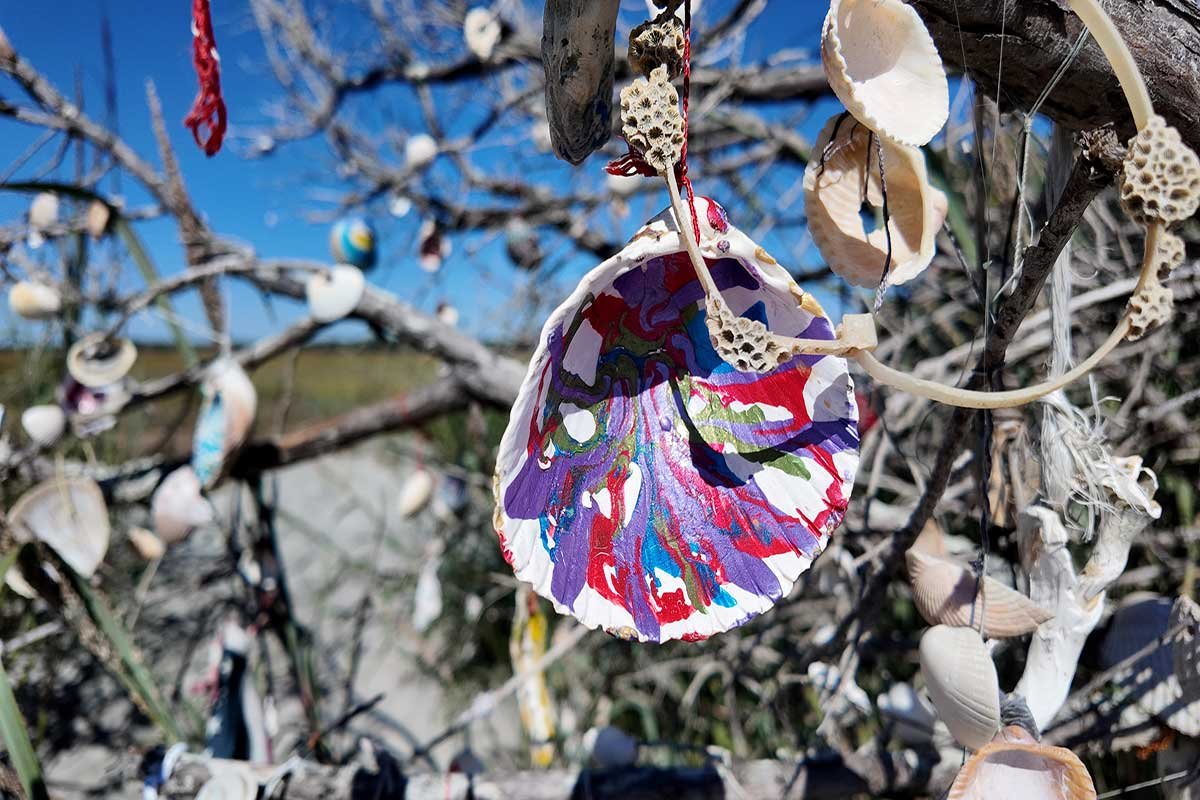
At the far end of Folly Beach, just north of the county park where the island begins to thin out and the crowds fall away, there is a tree that most visitors don’t know to look for. It grows from the soft sand of the Carolina shoreline, and when you get close enough, you start to notice what’s been left in its branches — shells woven into the limbs, necklaces of shells marking its trunk, small offerings pressed into the bark by people who came here with something on their minds.
This is the Folly Beach Wishing Tree. It has no official designation, no historical marker, no governing body. It exists because people decided it should, and they keep deciding that every time someone ties a shell to a branch and walks away.
The Edge of America
Folly Beach has always been a place that operates slightly outside the usual rules. The earliest known record of the island dates to 1696, when the land was deeded as a royal grant by the British Crown. At the time it was called Coffin Island, likely named after the Coffin family of Charleston or, according to local lore, for the coffins once washed ashore from shipwrecks. Pirates worked the nearby shipping lanes. Union soldiers camped on the dunes during the Civil War, launching assaults on Charleston Harbor from this narrow strip of sand.
Somewhere along the way the island shed the name Coffin Island and became Folly Beach, earning the nickname it carries today: the Edge of America. Despite its lively nature and an abundant supply of tourists, Folly is a world away from South Carolina’s more commercialized beaches. It’s still a great place to grab a beer, shake off your shoes, and enjoy the sunset with friends. That spirit — unhurried, a little unconventional, genuinely its own thing — is exactly the kind of place where a wishing tree takes root and stays.
What People Bring Here
People come to the wishing tree with a yearning for love, hopes for a sick person they wish well, dreams they’re trying to accomplish, or something very genuine and simple. The tradition is to find a shell on the beach, offer it to the tree, and say your wish under the open sky.
There is nothing complicated about this. No admission fee, no ceremony, no authority overseeing the process. You find a shell. You make a wish. You leave the shell behind for whoever comes next.
What accumulates over time in a place like this is something harder to quantify than shells — a layering of private moments in a public space, each one invisible to everyone except the person who left it. The tree becomes a kind of archive. A record of what people hoped for when they were standing at the edge of the Atlantic with their shoes off, briefly willing to believe that a shell tied to a branch might help.
It is one of the most remarkable locations in the Lowcountry to witness the sunset, and it offers a solitude that’s rare on a beach this close to Charleston. Both of those things are true at once, which is part of what makes it worth the walk.
Find a shell. Make a wish. Leave it behind.