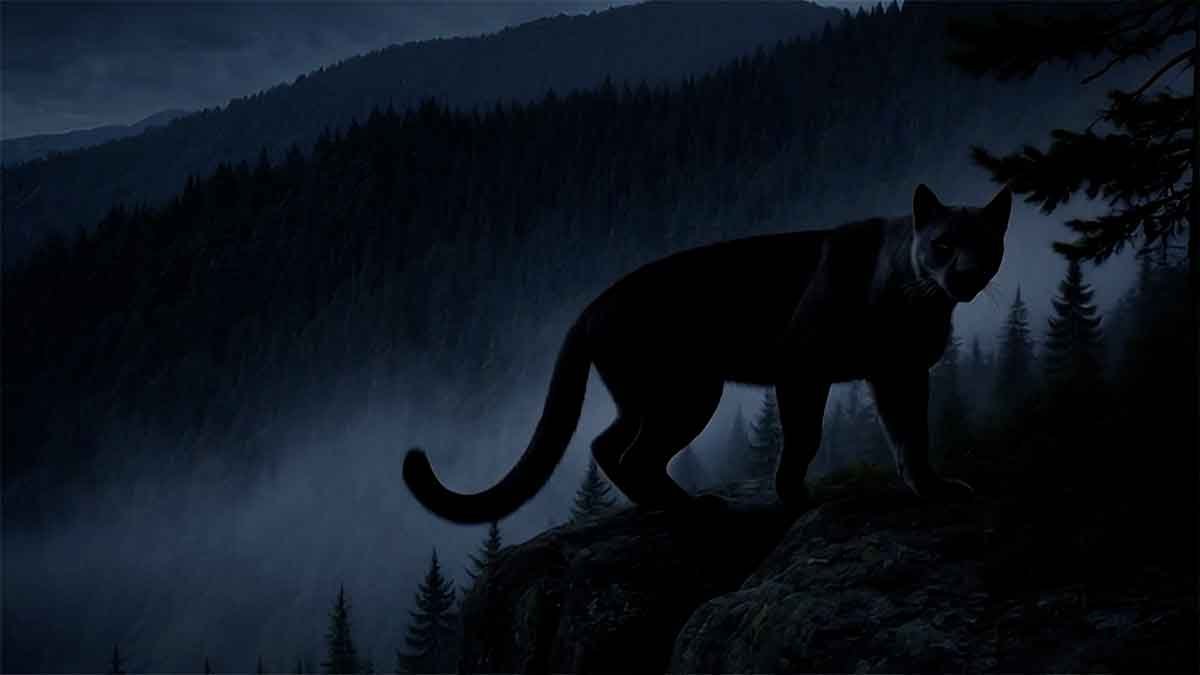
In the deep woods of Tennessee, Kentucky, and North Carolina, people spoke of something watching from the ridgelines. Not quite a cougar. Not quite human. And it’s never entirely gone away.
Before there were highways through the Appalachians — before radio signals reached into every hollow — there were only mountains. And stories. In the isolated communities tucked into the ridges and valleys of Tennessee, Kentucky, West Virginia, and North Carolina, people spoke of something moving at the edge of the firelight. Not quite a cougar. Not quite a spirit. Not quite human. They called it the Wampus Cat.
This isn’t a monster hunt. It’s something more interesting than that — a look at how a legend takes root in a landscape, what it reveals about the people who told it, and why it refuses to disappear.
Where the Name Comes From
The word “wampus” doesn’t have a clean origin. Some scholars believe it may derive from a mispronunciation of a Cherokee word — possibly Ewah or wampash — though the linguistic connection is debated. Others argue it’s simpler than that: a corruption of “catawampus,” an early 19th-century Appalachian term meaning something askew, fierce, or utterly out of alignment.
By the late 1800s, newspapers across the South were already using “wampus” to describe something wild and frightening. But the creature itself? That’s where folklore splits into multiple versions, each shaped by the community telling it.
The Cherokee Legend and the Ewah
One of the most widely repeated origin stories invokes Cherokee oral tradition. In this version, a Cherokee woman secretly followed the men of her village into a sacred hunting ceremony — something forbidden to women at the time. To avoid being seen, she wore the hide of a mountain lion. She was discovered. As punishment, she was cursed to wander the forest forever, half-woman and half-cat.
It’s a compelling story, but historians urge caution. No version of it appears in James Mooney’s comprehensive collections of Cherokee myths from the 1890s — the most thorough early documentation we have. Which raises a genuinely fascinating possibility: the legend may be a cultural blending, Native storytelling traditions filtered through and reinterpreted by settler imagination. That’s not a dismissal of the story. If anything, it makes it more interesting — a myth that formed in the friction between two worlds.
The 1920s Wampus Panic
In the early 1920s, something strange rippled through newspapers in Tennessee and Kentucky. Reports emerged of a mysterious creature killing livestock in rural mountain communities. Descriptions varied — as large as a bear, with glowing eyes, moving like a cat. But it was the sound that stayed with people. Witnesses described a high, thin wail, a woman-like scream that echoed through the hollows at night, sounding more like a person in distress than any animal most people had heard.
In 1924, headlines in East Tennessee announced a Wampus Cat stalking rural communities. Hunting parties organized. Men with rifles combed the hills. No creature was ever conclusively captured.
The timing is worth noting. The 1920s were a period of enormous disruption in Appalachian life — industrial logging and the expansion of railroads were reshaping communities that had been isolated for generations. Folklore scholars have long observed that legends tend to resurface in moments of cultural stress. The Wampus Cat, in this reading, may have functioned as a symbol of the wild pushing back against a changing world.
What Could It Have Been?
Strip away the supernatural, and several natural explanations emerge. Cougars once ranged widely across Appalachia and, even as they were being hunted out, phantom sightings persisted for decades. A cougar’s mating call — or a red fox’s scream — can sound indistinguishably human to a frightened ear, particularly in dense mountain terrain where sound behaves strangely and distances distort.
Black bears seen at dusk or standing on their hind legs can move in ways that seem almost human. Escaped exotic animals, not unheard of in the early 20th century, occasionally fueled local panics. And then there’s the simpler truth that fear amplifies everything. Once a name attaches to something unknown in the dark, every unexplained sound becomes evidence.
A Legend That Evolved
The Wampus Cat didn’t die out — it adapted. High schools across the South adopted it as a mascot, from Conway, Arkansas to Leesville, Louisiana. In some modern retellings, the creature has six legs; storytellers in the Ozarks explain the extra limbs as an evolutionary adaptation for running horizontally along steep mountain slopes without losing footing.
The creature shifts with the needs of the culture telling the story. When communities feel threatened, it’s a predator. When they feel nostalgic, it’s a symbol of regional identity. When they need a cautionary tale, it’s a warning. That flexibility is exactly why the legend persists.
Why We Need It
The mountains of Appalachia are older than the Atlantic Ocean. They’ve watched civilizations rise and fall, and in places where fog drapes the ridgelines at dusk and tree lines swallow the light early, it doesn’t take much imagination to feel watched.
Whether the Wampus Cat was a cougar, a misidentified bear, a cultural echo of an older story, or simply a legend that grew legs, it tells us something true about the people who carried it. People need legends — especially in landscapes that feel vast and untamed. Sometimes the most interesting question isn’t whether it was real. It’s why we needed it to be.